How to Decide Whether an Amazon KDP Book Niche Is Worth Testing
Publishing decisions often begin with a spreadsheet: keywords, competitor titles, prices, reviews, Best Sellers Rank, ad clicks, orders, and royalties. The difficult part is deciding which numbers are facts, which are estimates, what is missing, and what to do next.
A useful niche decision is not “this book will sell.” No research tool can honestly promise that. A useful decision is narrower: skip for now, collect more evidence, or proceed to a controlled test with a defined limit.
Separate facts from estimates
Public Amazon pages show price, reviews, publication date, formats, and Best Sellers Rank. These are observable signals, not a competitor sales ledger. Amazon explains that Sales Rank is relative to other books, combines recent and historical activity, and can change even when a book’s own activity stays the same. See Amazon KDP Sales Ranking documentation.
Third-party tools may convert BSR and other public signals into estimated sales or revenue. Those estimates can support consistent comparisons, but should stay labelled as estimates. Reviews are also a reader-response signal, not a direct sales count.
For your own books, KDP Reports provides orders, estimated royalties, KENP reads, formats, and marketplaces, with documented processing delays. Do not mix these records with competitor estimates as if they have the same confidence level.
Build a minimum evidence set
1. Keywords
- Exact keyword, source, and collection date
- Supplied search-volume or demand indicator
- Supplied competition level
- Marketplace and language
- Whether each value is observed, supplied, or calculated
Third-party search volume should be described as supplied search volume, not a verified number of Amazon searches.
2. Competitors
- ASIN or ISBN, title, and format
- Current price and BSR
- Review count, rating, and publication date
- Positioning: cover promise, subtitle, audience, and problem solved
Define the comparison rule before selecting books—for example, the first ten relevant organic results in the same format and marketplace.
3. Owned sales
For your own catalogue, include processed orders, units after refunds, estimated and finalized royalties, KENP reads, marketplace, format, and reporting period. Keep reporting delays visible.
4. Advertising
Useful Amazon Ads fields include impressions, clicks, spend, attributed orders, attributed sales, search terms, and targets. Amazon’s book advertising reporting guide describes separate report types. Ad-attributed sales are not the same as all KDP sales.
Apply evidence gates before scoring
Before calculating ratios or using a traffic-light verdict, verify that required columns exist, numeric values parse correctly, marketplace and currency are known, periods are comparable, files are complete and explicitly approved, and zero is not being substituted for missing data.
If a denominator is zero, conversion rate or ACOS may be unavailable. “Unavailable” is more truthful than a fabricated zero.
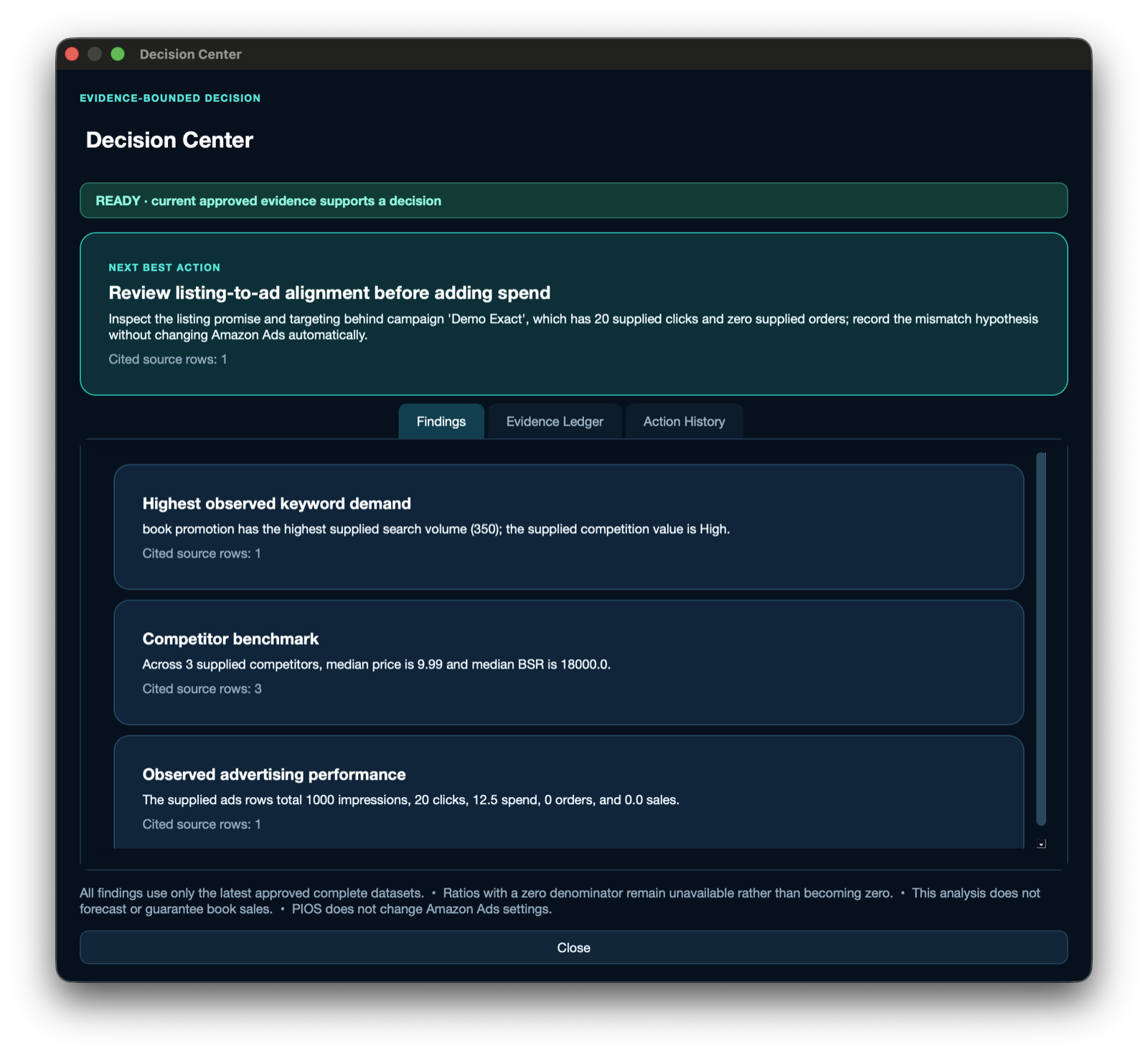
Turn analysis into a controlled decision
Red — skip for now
Use red when the supplied evidence shows a clear blocker or the opportunity exceeds the risk limit defined for the test. Red means the current evidence does not support more time or spend; it does not mean the book can never work.
Yellow — validate further
Use yellow when evidence is incomplete or contradictory. The next action should name the missing test: collect a larger competitor sample, verify a search term, inspect listing-to-ad alignment, or obtain a complete KDP export.
Green — proceed to a controlled test
Green is not a claim that a niche is profitable. It means the available evidence supports a limited experiment with a defined budget, duration, and success condition.
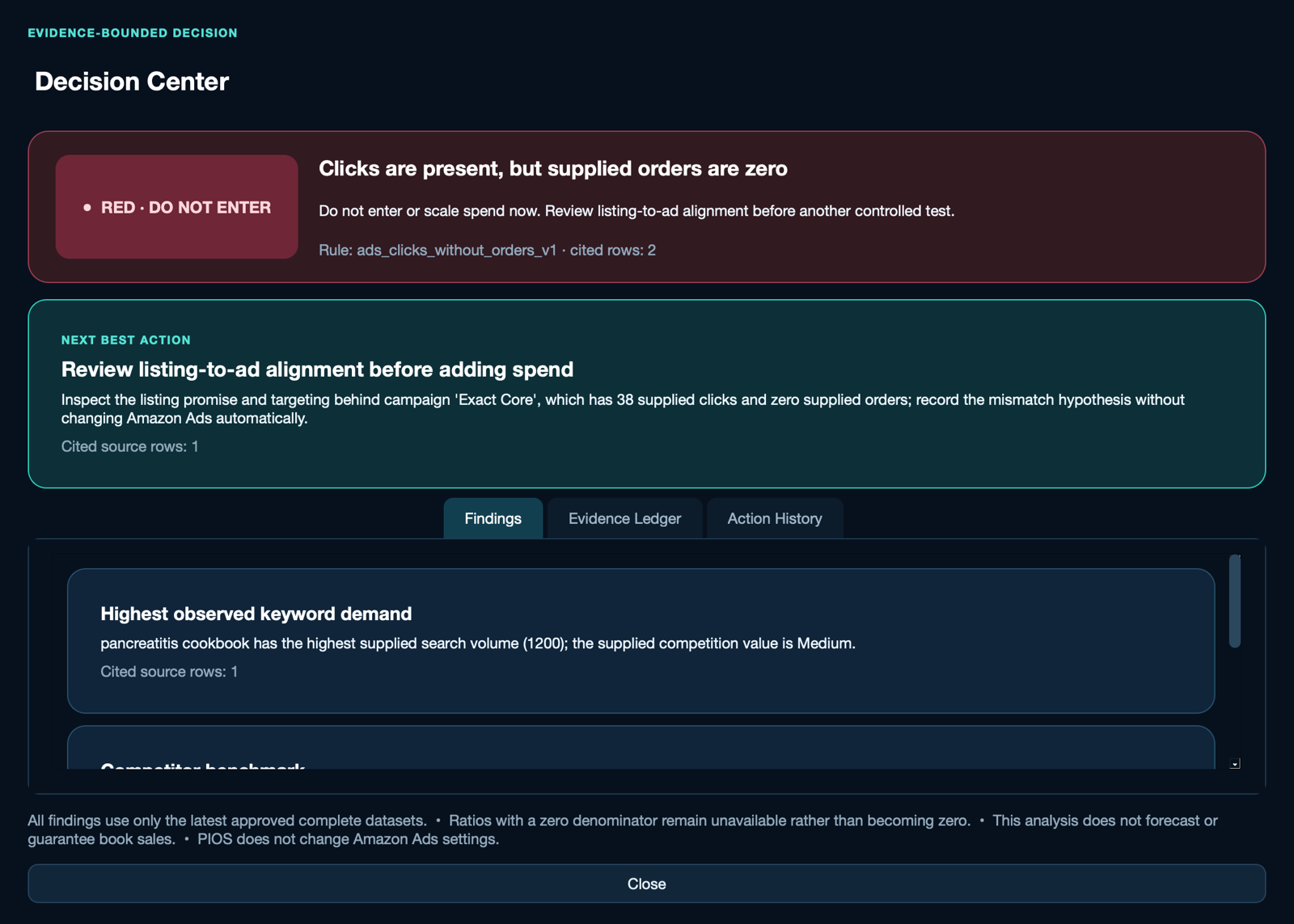
Why one Next Best Action matters
Dashboards can show dozens of findings and still leave the user uncertain. A decision system should reduce the result to one highest-priority action while preserving the supporting detail. The action should be recorded with the evidence version that produced it, so history shows what changed and why.
What PIOS is building
PIOS is a bilingual desktop prototype for authors, KDP publishers, and small publishing teams. It imports CSV, TSV, TXT, and XLSX evidence; previews normalized tables before approval; separates facts, estimates, and missing evidence; produces a source-linked red, yellow, or green decision; preserves an evidence ledger and action history; and recommends one Next Best Action.
PIOS does not forecast or guarantee book sales and never changes Amazon Ads automatically.
Request a pilot Decision Report
Bring one book idea, a competitor table, a keyword export, or your own KDP and Amazon Ads reports. We will identify what is verified, estimated, missing, and which single next action is supported by the evidence.
Please do not send account passwords, API keys, payment information, or unredacted personal data.