Should you publish this book? Let your own evidence answer.
Other tools show you niche data. PIOS tells you what to do with it: launch, fix, or wait — and explains why. Before you spend the months and the ad budget.
The closed beta is open now. Ten people get free access for the whole beta and one hand-made analysis of their own data. In exchange: honest feedback — what worked, what broke, what is missing.
The build goes out to testers on 12 September.
This counts down to the build, not to a closing door: applications stay open afterwards, and places are confirmed as they are reviewed.
How to improve your book’s odds
Odds improve through decisions made before launch, not through luck. PIOS gathers what can actually be checked in your niche — demand, competitors, prices, ad bids — and turns it into one decision.
It answers the question that actually costs money:
Does your evidence justify the next four weeks of work and the next advertising budget?
The answer is one of three:
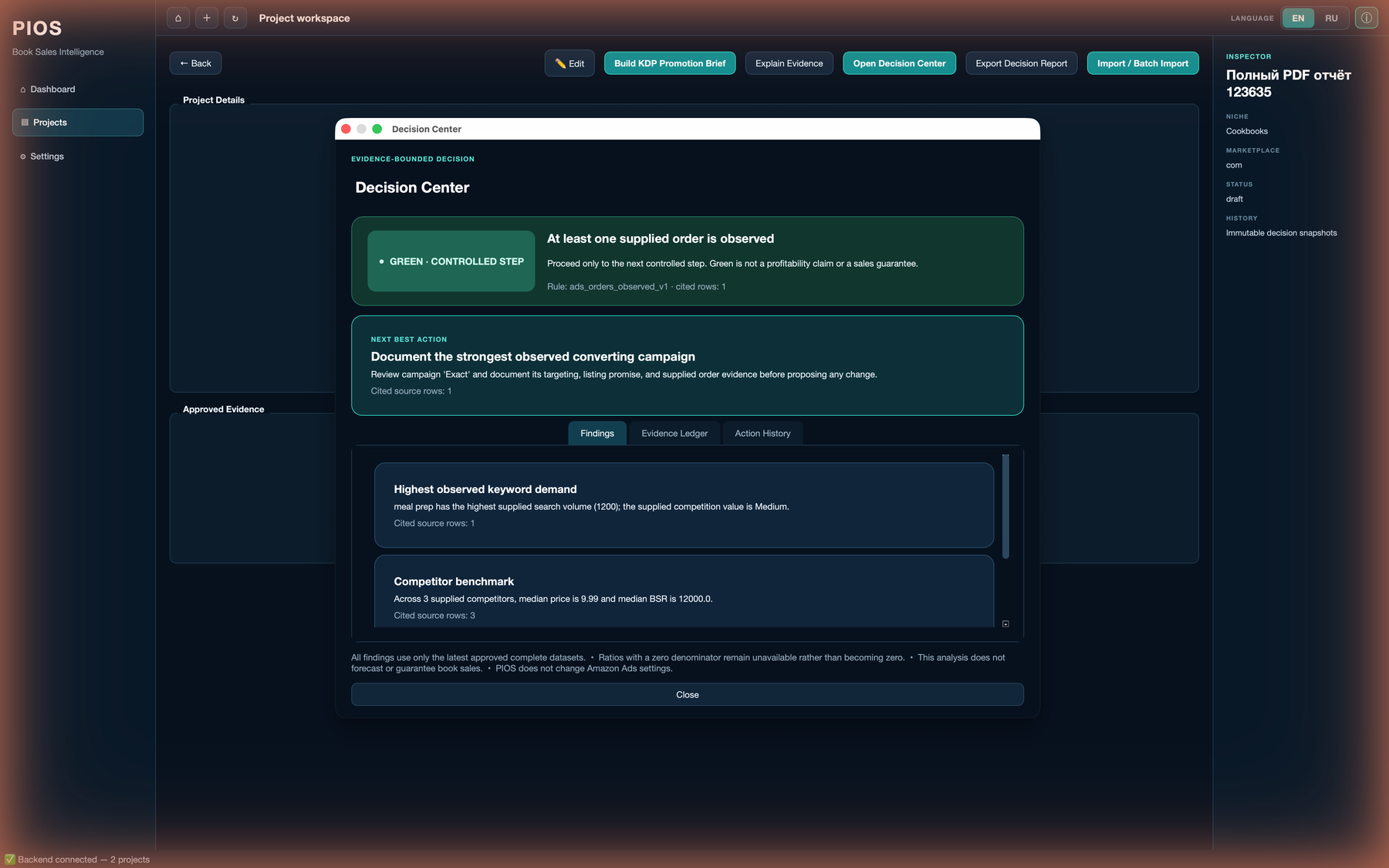
- 🔴 Red — not now. There is a blocker, or the risk exceeds the limit you set yourself. Not “bad niche”, but “today the evidence is not there”.
- 🟡 Yellow — too early to call. The picture is incomplete or contradictory, and PIOS names the specific test that is missing.
- 🟢 Green — worth trying. Not “this will sell”, but “the evidence supports a limited test with a defined budget, duration and success condition”.
And plainly, so there are no surprises: no tool can promise you a book will sell — none. Amazon states that Best Sellers Rank is relative, and third-party services give estimates, not facts. We do not turn an estimate into a confident revenue number. We help you avoid spending months and budget where the evidence does not justify it — and commit with confidence where it does.
And with every verdict you can see why: the rule that fired, and the rows it read.
This is you if you recognise even one of these
- You are picking your first niche and have no idea which signals separate a working one from a dead one.
- You are rebuilding the same competitor table for the third time because you cannot remember which numbers were real and which were “roughly”.
- You entered a niche on instinct, then spent three months and an ad budget working out why the instinct was wrong.
- You look at “search volume” in a keyword tool and cannot tell whether it was measured, modelled, or invented.
- You open a report with forty metrics, feel the overload, and close it without deciding anything.
- A month later you cannot remember why you made the call you made.
Just starting out is not a problem. You have no KDP reports or ad statistics yet, but a keyword export and a competitor table you either have or can assemble in an evening. That is enough for a first verdict — and PIOS will mark honestly what is still missing from the picture.
If none of this lands, PIOS is probably not for you. We will say so plainly rather than talk you into it.
What PIOS does today
A plain desktop application for Mac and Windows, in English and Russian. It runs locally: your files stay with you.
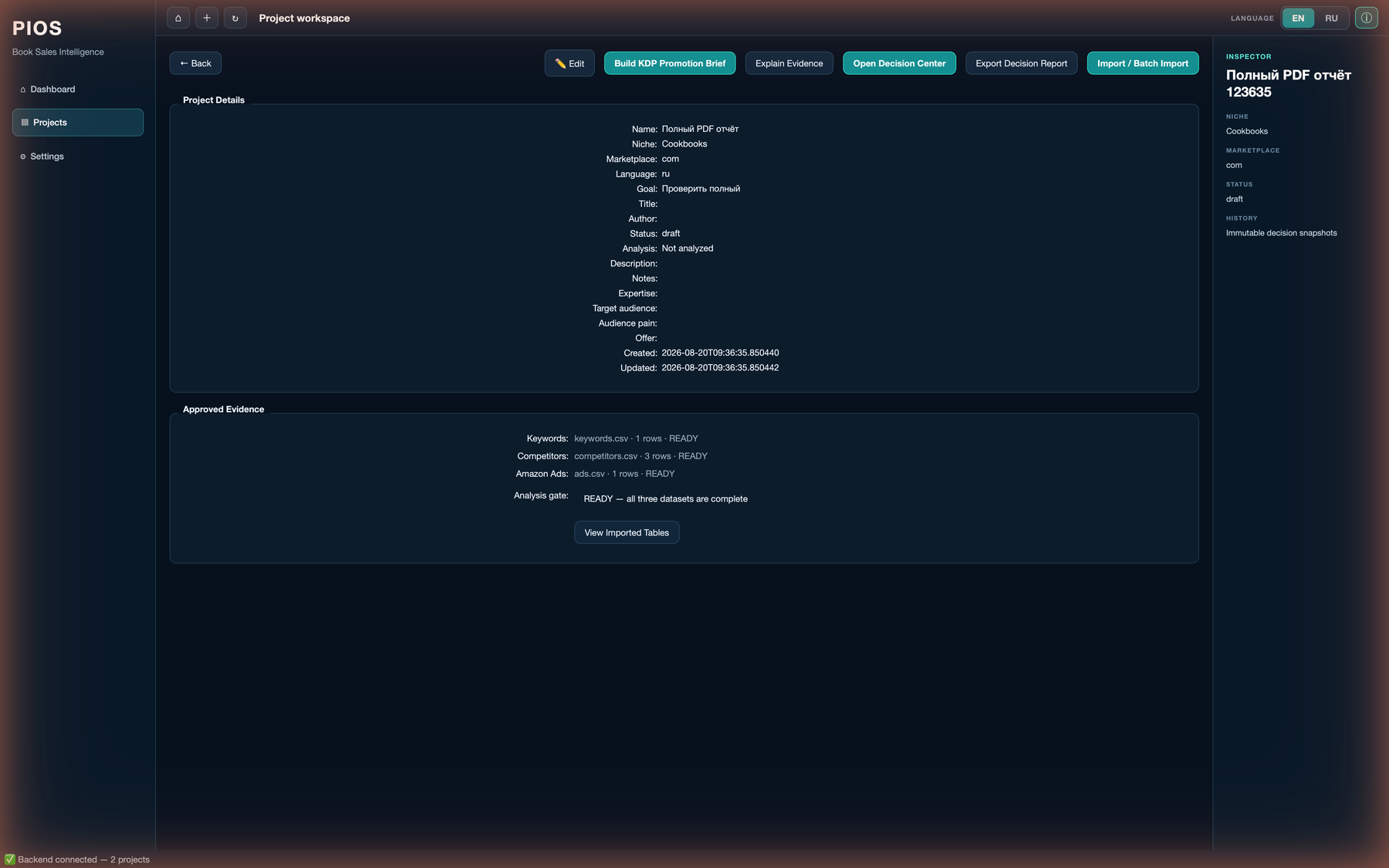
- Projects. Every book or idea is a project with a niche, a marketplace, and the history of every decision.
- Import without pain. CSV, TSV, TXT, XLSX: keywords, competitor tables, KDP reports, Amazon Ads reports.
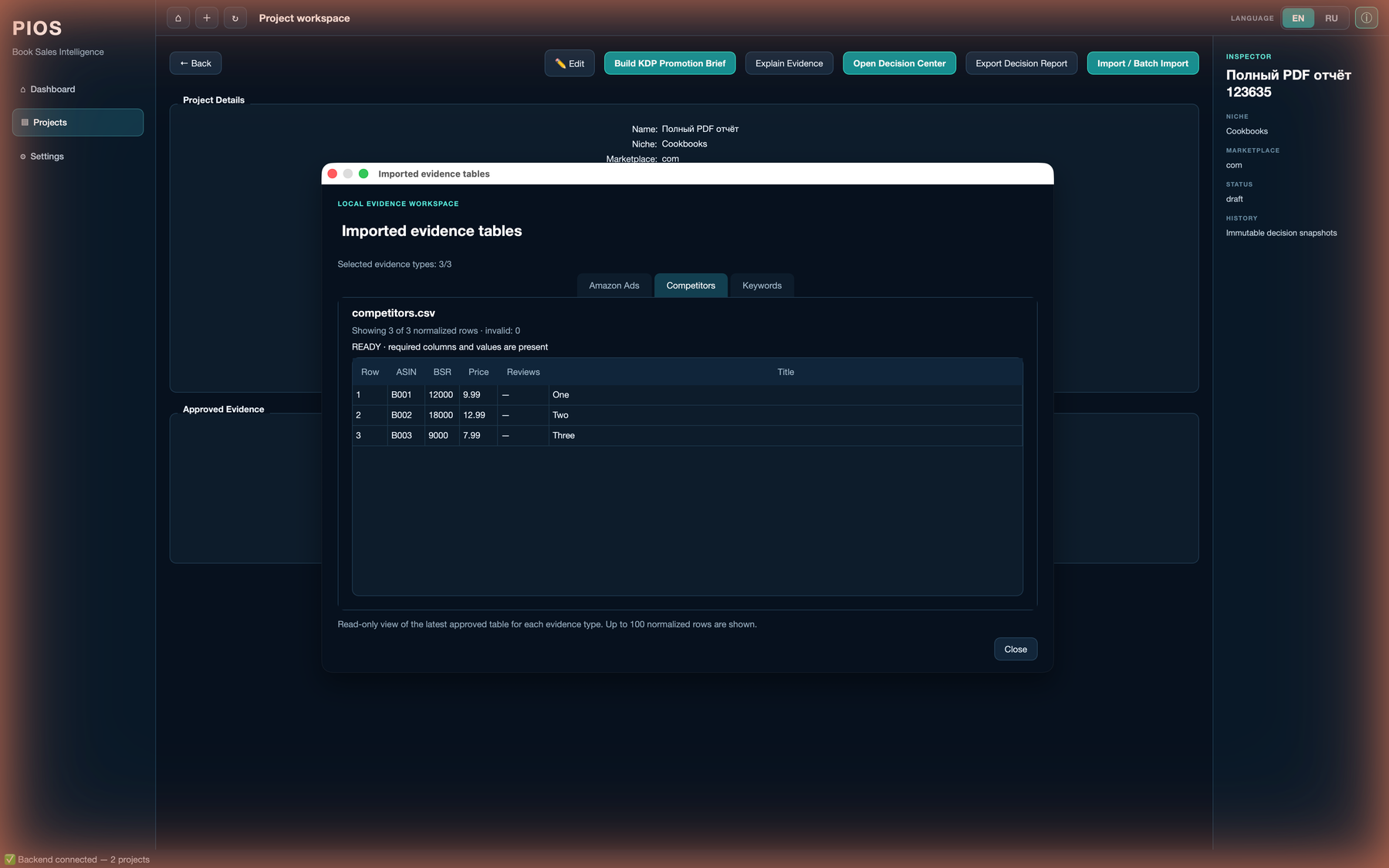
- No black boxes. Before anything reaches the analysis, you see it as a table and approve it by hand.
- Honest labelling. This is a fact from your report. This is an estimate from a third-party service. And here there is no data. The label travels with the number all the way to the verdict.
- Decision Center. Instead of noise, one verdict linked to the rule and the source rows.
- Next Best Action. Not twenty suggestions — one that matters most, right now, from your evidence.
- Decision history. Every import, approval and verdict is kept. A month later you open it and the logic is still there.
How the traffic light works is set out in how to decide whether a KDP niche is worth testing.
The arrangement
This is not a mailing list you subscribe to. It is an exchange, and both sides put something real on the table.
You get
- Free access to the build for the whole beta period.
- One analysis of your evidence, done by hand. One book idea or one title. You get back: what is verified, what is an estimate, what is missing, and the one action the evidence supports. Five business days from the moment we accept your files.
- Founding-user pricing at commercial release — agreed with you personally before the beta ends.
- A direct line to the person writing this. Your export format unsupported? That parser becomes a beta task, not a line in a future plan.
We get
- Your real files. Not demo data. A niche you are actually weighing, or a title you already publish.
- The exports that break PIOS. A failed import is worth more than any compliment.
- One short debrief — email or a twenty-minute call — after roughly two weeks.
If PIOS cannot say anything useful about your evidence, we will tell you so. No dressing it up: that is the entire point.
What PIOS does not do
It does not forecast or guarantee sales. It does not manage your advertising and does not connect to your Amazon account. Third-party search volume stays an estimate, not a verified count of searches. Where a denominator is missing, the metric is marked unavailable — a zero is never substituted for a gap.
The application runs locally: your files sit on your own disk and never leave it on their own. They reach us in exactly one case — when you send them for the analysis.
Ten places, and we read every application
Ten places. Deliberately few: ten people working on live data will break this faster and more usefully than a hundred clicking through demo files.
We select; we do not simply take the first ten to reply. Everyone who writes gets an answer: a place, the waiting list, or an honest “not your case yet” with the reason.
Bring us one real decision
Tell us what you publish or are about to publish, which marketplace you work in, and what evidence you already collect. If there is a specific call in front of you right now — a niche you cannot judge, a title that is slipping, a first book you are afraid to launch — describe it. That is the fastest way for both of us to find out whether PIOS is worth your time.
We reply within 24–48 hours. Confirmation that your application arrived comes immediately.
Please do not send account passwords, API keys, payment information, or unredacted personal data. Pricing is agreed case by case before any files are accepted, and applying carries no payment obligation.